George Cavendish
Wolf HallGeorge Cavendish, Thomas Wolsey’s gentleman usher and later biographer, is a loyal witness to the cardinal’s fall whose sensitivity gives political dispossession a personal and theatrical shape. He watches the king’s commissioners dismantle Wolsey’s household, frets over the practical hardships of exile, and later reenacts the story of Anne Boleyn and Henry Percy for Thomas Cromwell. In his presence, history is not only the transfer of possessions and offices: it is a performance recalled by those who had to live through it.
Identity and Service
Cavendish serves Wolsey as his gentleman usher, occupying a household role that places him close to the cardinal without making him a principal political actor. At York Place, he remains at Wolsey’s side while royal commissioners inventory and remove the cardinal’s possessions. He is especially alert to the material and human labor embedded in that seizure: when embroidered vestments are tossed into travelling crates, he asks the commissioners to line them with extra cambric, lest they shred work that has taken nuns a lifetime. His concern for the workmanship does not halt the confiscation, but it shows what his loyalty attends to: not merely the value of Wolsey’s property, but the care that went into making it.
The novel frames Cavendish as emotionally exposed. His face is described as raw with dismay as he follows the commissioners through the rooms, and his anxiety repeatedly turns to immediate practical questions. When the cardinal announces that the household is to go to Esher, Cavendish points out that the house is empty, without a bed, linen, firewood, or even a pot and spit. His attention to such objects brings the scale of the fall down from the level of royal policy to the needs of people who must sleep, eat, and travel.
The Removal from York Place
Cavendish’s distress unfolds amid the stripping of Wolsey’s household. Letters from popes and European scholars, gospel books, tapestries, hunting scenes, plate, jewels, and vestments are sorted, weighed, packed, or taken for the king’s libraries. Wolsey’s treasurer, Sir William Gascoigne, directs the commissioners’ attention around the rooms; Cavendish follows, watching the cardinal’s world become an inventory. He asks Thomas Cromwell whether they can get the commissioners out before dark, but Cromwell answers that the work can only be finished if they help it proceed properly.
When Gascoigne reports a rumor that Wolsey is to be sent to the Tower of London, Cavendish is already struggling with the consequences of the move to Esher. Wolsey dismisses the rumor and says the household will go upriver, by barge, with horses to meet them at Putney. Cavendish responds that the barge has not yet been seized and the horses remain available, but he cannot conceal his fear that the party has no adequate arrangements at its destination. Wolsey tries to stiffen him by urging him to exercise ingenuity and reminding him that they have faced harder tasks. The exchange reveals a relationship in which the master offers encouragement and the usher voices the practical fear that encouragement cannot quite dispel.
Witness to Wolsey’s Fall
On the journey upriver, the cardinal’s flags—the Tudor rose and the Cornish choughs—fly from the barge, but the spectators along the bank do not greet him with sympathy. Their hooting and booing make plain that Wolsey’s public standing has collapsed as sharply as his household’s fortunes. Cavendish tries to explain the crowd as a force that always wants change and pulls down a great man for the novelty of seeing him fall. He also reflects that princes are not obliged to be consistent, and warns that those who serve them should be wary of their changing moods.
Cavendish’s account of popular fickleness is tested by Wolsey’s grief. The cardinal speaks of years spent in the king’s service, his repeated labor and his efforts to spare rioters from execution. Cavendish answers with the bitter lesson of service to a prince, but the scene does not reduce him to a detached observer. As they exchange words about the crowd and the king, Wolsey’s tears seep from beneath his closed lids; Cavendish takes Cromwell’s gesture toward his own throat as a sign that he understands the danger of speaking too freely. The two men look at one another, embarrassed by how much has been said and felt, while Wolsey grips Cavendish’s hand.
At Putney, Cavendish watches Wolsey struggle to mount his mule. Cromwell calls on servants to help, while Cavendish cries out at the approach of a single horseman, fearing an arrest. It is Harry Norris, sent by the king not to take Wolsey into custody but to offer words of comfort and deliver a familiar ring. The cardinal falls to the ground when he receives it, presses it to his lips, and prays for the king. Cavendish is present at this sudden reversal: the journey that has looked like a public expulsion is accompanied by a token suggesting that the king’s displeasure may not be final. The moment does not restore Wolsey’s security, but it reveals the uncertainty at the heart of his fall.
History Reenacted
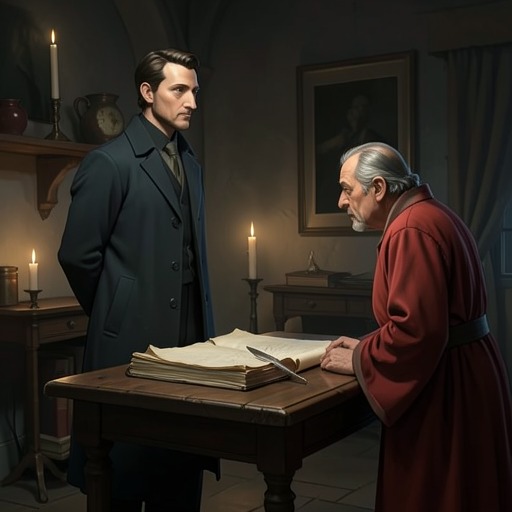
Years later, in 1529, Cromwell asks Cavendish what happened between Wolsey, Henry Percy, and Anne Boleyn. The cardinal’s own account has been chilly and dismissive, so Cavendish offers a more vivid version by turning recollection into a small play. In a fireless room at Esher, he tells Cromwell to stand and choose whether to be Wolsey or the young heir; Cavendish shifts his position and asks him to look troubled, then changes roles himself. His gestures and voice conjure the young Percy as gangling, blushing, and in love, and the cardinal as a presence against whom Percy’s case must be made.
The reenactment gives the dispute a sequence and a human awkwardness. Percy argues that his lineage is good and that he and Anne have made a marriage contract as binding as a true marriage. Wolsey, as Cavendish performs him, reacts with alarm at the possibility of a secret matrimonial proceeding and threatens to summon Percy’s father so that they can contrive to annul it. Percy hangs his head. Cavendish’s performance supplies Cromwell with a scene he has not heard directly, while its theatrical form also keeps the limits of recollection in view: the past reaches the listener through the witness’s choices of role, gesture, and emphasis.
Narrative Significance
Cavendish links the novel’s political history to the fragile work of remembering it. At York Place, he sees power made visible through objects removed, weighed, and packed; on the river, he sees it measured in public hostility, whispered interpretation, and a ring delivered from the king. Later, he makes an earlier court dispute present by staging it for Cromwell. His concern for nuns’ embroidery, the household’s lack of basic equipment, and the cardinal’s physical difficulty mounting his mule all resist an account of political change conducted only through titles and policy.
His role also sharpens the contrast between official performance and private feeling. Wolsey once moved in public with a procession and could turn his scarlet clothing into a display of command; now the commissioners price and carry off the materials of that magnificence, while Cavendish worries about beds and firewood. Yet the usher’s recollections preserve more than the spectacle of decline. By remembering how people spoke, hesitated, and embodied their roles, he makes the past an event that can be acted again—but never entirely separated from the grief and uncertainty of its witnesses.